
Beyond Care Coordination: How AllCare.ai Is Changing the Way Senior Care Is Delivered
Senior care has never been short of people who want to help. What it has struggled with is getting everyone involved to work together, consistently and at the right time.

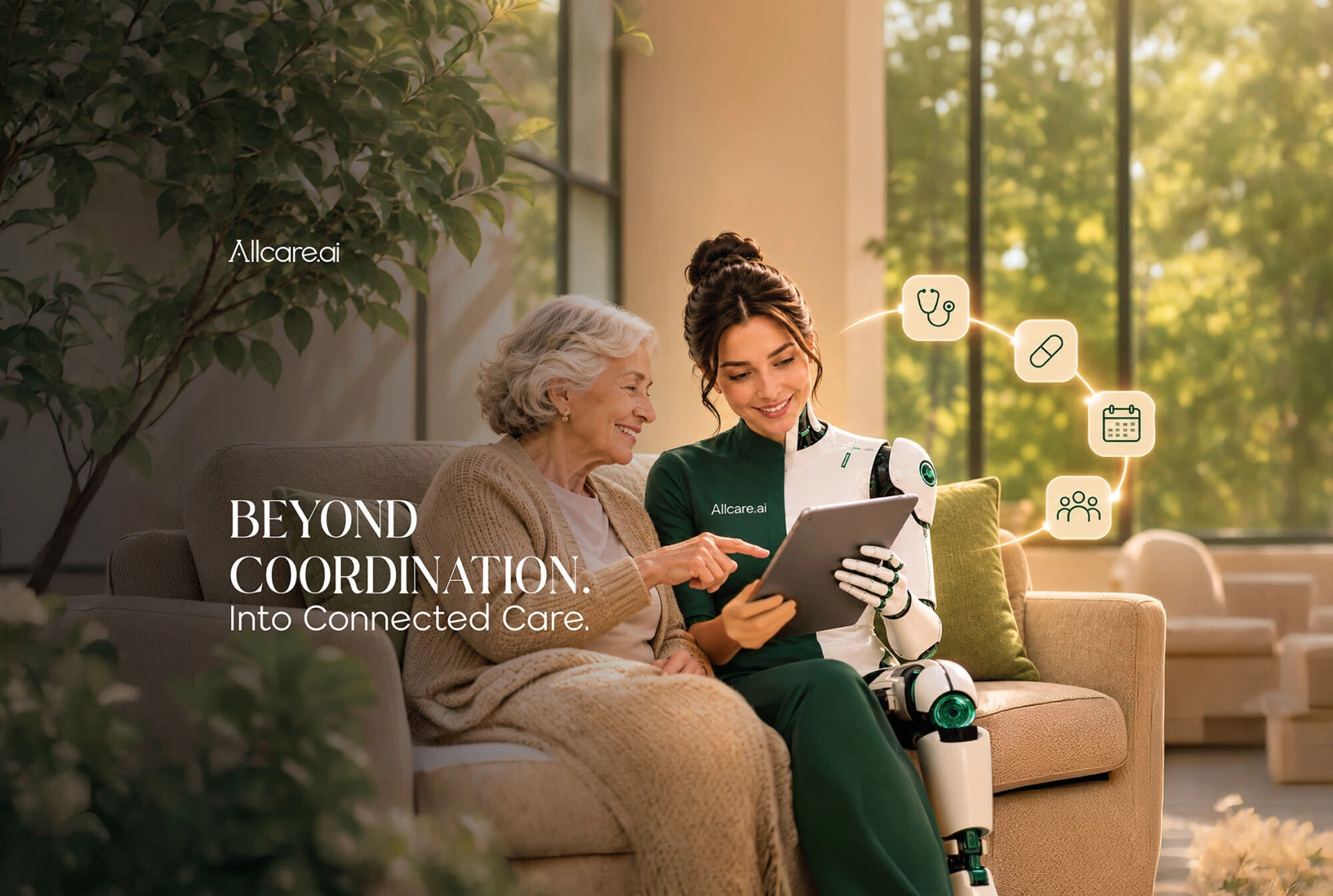
Bringing clinical care, intelligent technology, and real execution together in one connected system.
Senior care has never been short of people who want to help. What it has struggled with is getting everyone involved to work together, consistently and at the right time.
A physician makes a recommendation, a facility needs to arrange the next step, a pharmacy is waiting for an updated prescription, and a family member wants to know whether anything has actually happened. Each person may be doing their job, but the process connecting them is often fragmented.
That fragmentation has become one of the biggest challenges in senior care. Important decisions get delayed, staff spend valuable time coordinating instead of caring, and families are often left trying to understand who is responsible for what.
Technology has helped improve parts of this process, but much of what exists today still depends on people manually connecting the pieces.
AllCare.ai was built around a different approach: rather than creating another platform to help people coordinate care, why not build a care delivery system where the coordination is already built in?
That distinction is at the center of what AllCare.ai does, and why its model is different from traditional healthcare software, remote care coordination services, and conventional medical practices.
A Care Provider Built Around Technology, Not Just Supported by It
Most healthcare technology companies build products for care providers to use. They offer platforms for managing patient records, scheduling appointments, coordinating referrals, or tracking clinical activities.
These tools can be valuable, but they still leave the actual work to the organizations using them.
AllCare.ai operates differently.
It is an AI-native healthcare delivery model that combines medical professionals, on-site care teams, and an intelligent operating system into one connected service.
Instead of giving a senior living facility another system to manage, AllCare.ai brings the clinical services and the technology needed to deliver them.
A primary care provider orders the care, AllCare.ai's team carries it out, and Alli, the company's AI operating system, manages the coordination required to move each step forward.
That includes identifying what needs to happen, assigning responsibilities, organizing schedules, tracking completion, preparing documentation, and supporting the billing process.
The difference is practical. A facility is not purchasing software and then figuring out how to make it work. It is receiving healthcare services delivered through a system designed to manage the operational complexity behind them.
For participating facilities, the model is offered at no direct cost, with AllCare.ai receiving reimbursement for eligible covered services through insurance.
This gives senior living communities access to additional healthcare capabilities without requiring them to build an entirely new care coordination operation themselves.
What Changes When Care Becomes Proactive?
One of the persistent limitations of traditional care delivery is that much of it begins only after someone notices a problem.
A resident needs assistance, a family member calls, a medication discrepancy is discovered, or a facility employee realizes that an important follow-up has not happened.
The system then starts responding.
AllCare.ai combines that reactive model with a proactive approach, where care requirements are identified and scheduled based on each patient's clinical needs and care plan.
Routine assessments, medication reviews, follow-up visits, referrals, and other services can be organized before someone has to request them.
When something unexpected happens, such as a hospital discharge, a fall, or a change in a patient's condition, the same operating system can initiate the appropriate workflow.
This means planned care and unexpected care needs are managed through a connected process rather than separate channels of communication.
Consider a common situation involving medication reconciliation.
A resident returns from the hospital with changes to their medication list. Traditionally, the facility may need to contact the physician, confirm the updated medications, communicate with the pharmacy, inform the family, and ensure that the medication administration record reflects the changes.
Each step can involve a different person, system, or conversation.
With AllCare.ai, the process is organized as a defined workflow.
Alli gathers available medication information, coordinates the required tasks, and helps route the work between remote care staff, on-site Care Partners, and licensed clinicians. The clinician reviews and authorizes the appropriate changes, while the system supports documentation and communication with the parties involved.
The people responsible for medical decisions remain involved. What changes is the amount of manual coordination needed to move from one step to the next.
The goal is not simply to make individual tasks faster. It is to reduce the gaps between them.
The Technology Behind the Care
At the center of AllCare.ai's model is the idea that complex healthcare operations can be broken down into clearly defined, repeatable activities.
Instead of treating every care request as something that needs to be planned from the beginning, AllCare.ai has developed a structured catalogue of service units and workflows.
A service unit represents a specific job. It defines what needs to happen, who is responsible, where it takes place, what triggers it, and what should happen after completion.
A workflow connects those units into a sequence that can move across different roles and organizations.
As of October 2026, AllCare.ai's operating catalogue included 222 service units organized into 213 workflows across 65 groups, covering activities such as onboarding, clinical visits, referrals, medication management, pharmacy coordination, and care transitions.
This structure allows Alli to manage work consistently, even when different patients need different services.
Behind it are three connected capabilities.
Connected patient information. Alli brings together information from relevant clinical and operational sources, including electronic medical records, pharmacies, laboratories, and other healthcare systems, helping care teams work with a more complete picture of each patient.
Intelligent coordination. The platform uses specialized decision and routing engines to organize care plans, identify required activities, assign tasks, and track progress.
Automated workflows. Repetitive administrative and coordination activities can increasingly be handled by AI, while clinical judgment, patient interaction, and physical care remain with appropriately qualified people.
The result is a system designed to make care delivery more consistent without requiring a proportional increase in administrative staff as the number of patients grows.
And this is already operating in real clinical environments.
In October 2026, AllCare.ai recorded 3,737 service-unit occurrences across 1,692 patients, with routing technology helping organize the work into daily schedules.
Those numbers represent more than software activity. They reflect care-related work being assigned, tracked, and delivered through an operating model that connects technology to actual services.
AI Should Reduce the Work Around Care, Not the Care Itself
Healthcare is one of the few industries where the human element is not simply part of the experience. It is essential to delivering the service.
A patient may need a physical examination, a clinician's judgment, reassurance during an appointment, or someone physically present to assist with a task.
Those responsibilities cannot be treated as interchangeable with software.
But much of the work surrounding those moments is different.
Scheduling, routing, gathering information, preparing documentation, following up on outstanding tasks, and coordinating between organizations can consume significant amounts of staff time.
These are areas where AI can take on a much greater role.
AllCare.ai's operating model separates the activities that require human clinical or physical involvement from those that can be automated.
That separation is important because it allows the company to expand its use of AI without having to redesign its entire care delivery process each time a new capability becomes available.
A task performed manually today can become an automated workflow tomorrow, while its place within the overall care plan remains the same.
As of October 2026, AllCare.ai reported approximately 33% automation across its operations, with a target of reaching 75% by 2028.
The direction is clear, although achieving that target will depend on technical capability, clinical validation, and regulatory requirements.
The purpose is not to remove people from situations where their expertise or presence matters. It is to reduce the amount of time skilled people spend on work that does not require their skills.
For care teams, that can mean fewer administrative interruptions. For clinicians, it means more time for clinical decisions. For residents, it means a better-connected experience where the next step is less likely to depend on someone remembering to make another call.
From Selling Software to Delivering the Service
There is a broader shift taking place in how AI companies approach traditional business models.
For years, software companies have primarily sold tools that make employees more productive. Organizations purchase the software, train people to use it, and remain responsible for completing the work.
A newer model, often described as Services as Software, changes that relationship.
Instead of selling access to a tool, the company delivers the service itself, using technology to manage much of the work behind it.
AllCare.ai applies this concept to senior care.
The facility does not need another care coordination dashboard that employees must constantly monitor. It needs medication reviews completed, referrals followed through, clinical visits organized, and residents receiving appropriate care.
Those are the outcomes the operating model is designed to deliver.
What makes healthcare more challenging than many other applications of Services as Software is that the work cannot be entirely digital.
It involves licensed professionals, clinical accountability, payer requirements, physical environments, and direct interaction with patients.
AllCare.ai's approach brings those elements into the same operating model rather than treating technology and healthcare delivery as separate businesses.
The AI coordinates the process, while the clinical and care teams perform the responsibilities that require people.
This is also where the business model differs from conventional healthcare software. Revenue is linked to delivering reimbursable healthcare services rather than charging facilities for software access.
Why Owning the Full Care Process Matters
There are several types of companies working to improve senior care, and many address legitimate needs.
Healthcare software providers help organizations manage information and operations. Remote coordination companies help patients and families navigate services. Traditional medical groups deliver clinical care through their own professionals.
Each model addresses part of the problem.
AllCare.ai's distinction is the combination of clinical delivery, on-site execution, and AI-powered coordination within one system.
When an order is created, the same connected operation is responsible for organizing the next steps, assigning the work, supporting execution, and tracking its completion.
This reduces dependence on multiple disconnected organizations to move a single care request forward.
It also changes how AllCare.ai reaches patients.
Rather than relying exclusively on acquiring individual seniors or families, the company begins by working with senior living communities, where many residents can benefit from a coordinated care model.
An on-site presence helps establish relationships with facilities, supports direct patient interaction, and makes it easier to connect clinical services to day-to-day needs.
The model is designed to be repeatable across locations because the underlying workflows do not need to be reinvented for each new building.
That combination of physical execution and a reusable technology infrastructure is an important part of AllCare.ai's approach to scaling care delivery.
A new service can be introduced by defining its required activities, assigning the appropriate clinical responsibilities, and connecting it to the existing operating system.
The company can expand what it delivers without rebuilding the entire coordination process every time.
The Next Step: Taking the Same Model Into Seniors' Homes
Senior living communities are the starting point, but they are not the limit of the model.
Millions of older adults prefer to remain in their own homes for as long as possible. Yet aging at home often makes coordination more difficult.
Instead of having multiple residents and care resources within one community, services must be organized across different homes, providers, pharmacies, caregivers, and family members.
The underlying needs remain familiar: regular clinical oversight, medication management, follow-up care, early identification of concerns, and reliable communication.
AllCare.ai's longer-term direction is to extend its care delivery model beyond senior living communities and into seniors' homes.
The same principles would apply: a personalized care plan, defined service workflows, intelligent coordination, and human care delivered where it is needed.
The operating environment changes, and home-based delivery introduces additional logistical challenges, but the foundation remains the same.
This is an important part of the company's vision because improving senior care is not only about what happens inside a facility. It is also about making coordinated care more accessible wherever an older adult chooses to live.
A Different Way to Think About the Future of Senior Care
The healthcare industry has spent years investing in better systems, more data, and new ways for providers to communicate.
Those investments matter. But access to information alone does not guarantee that care will be delivered.
Knowing that a resident needs a medication review is not the same as getting it completed. Recording a referral is not the same as ensuring the patient receives the service. Creating a care plan is only the beginning of making that plan useful.
The challenge is connecting decisions to execution, consistently, across the people and organizations involved.
That is the problem AllCare.ai is working to solve.
Its approach combines the clinical responsibilities of a healthcare provider with the operational capabilities of an AI-native platform, creating a model where technology does more than support the people delivering care. It helps organize and move the work forward.
For senior living communities, this means access to care services without taking on another layer of operational complexity. For clinicians and care teams, it means spending less time managing the process around care. For seniors and families, the intended result is a more connected, reliable experience.
And as the model expands from senior living communities into seniors' homes, the objective remains consistent: make it easier for the right care to happen, at the right time, with fewer unnecessary steps in between.
AllCare.ai is not simply building software for senior care. It is building a different way to deliver senior care, with AI running the coordination and healthcare professionals delivering the care that people need.
Better care starts with a conversation.
Meet the team behind the follow-through.
Let’s Talk ↗


Get Started
Ready to close the gap?
Enrollment is simple, and programs are billed through insurance. The first visit happens within 10 business days of consent, and your Care Partner is ready to start.